
16 Oct The Road Crew – Part One
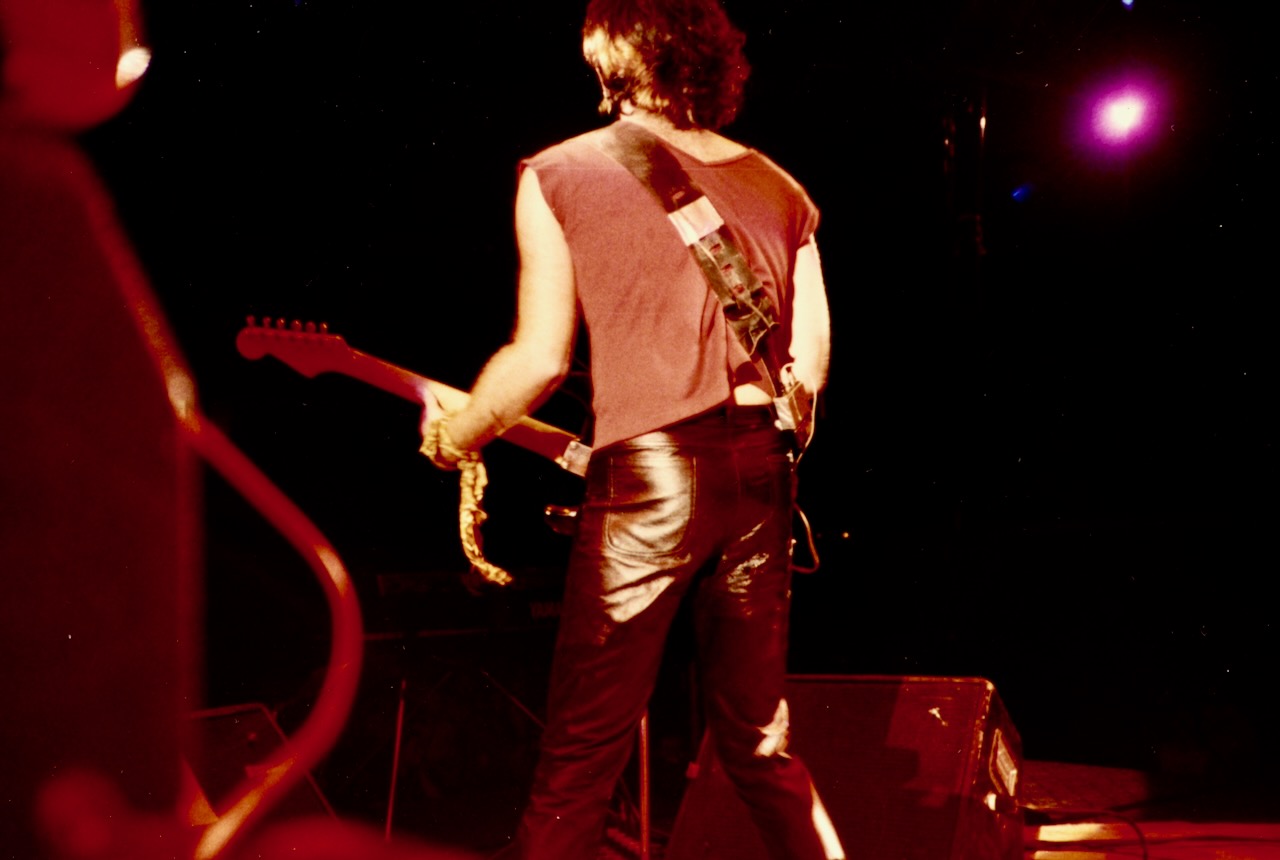
Okay, Gentle Reader(s), we’re going to try out something a bit different here at InkyInkInc. As you may well have gleaned from anything more than a cursory examination of these pages over the years, Your Humble Narrator is an alleged musician as well as an alleged writer. Way way back in the day I became friends with a fellow musician by the name of Steve LaRue, whom I typically refer to in these pages as the Goof, or Goofa. The Goof was my closest friend and we saw and/or talked to one another every single day of every single week for many years. We were bandmates, roommates, artistic collaborators and we even toured America together back in the early ’80s. The Goof left us back in 2017 and even before he checked out I had started working on a sort of hopped-up memoir of our time on the road. Steve never got to read any of it but after he died I applied myself to the project with sporadic vigor and finally came to what I considered to be a finishing point about a year and a half ago. Since then, it has been edited and re-edited again, and that process could potentially go on forever. With a bit of gentle prodding from a friend or two, I have decided to share a bit of the manuscript with you. Love it or hate it, you can let me know what you think—that’s what the CONTACT page is for. The full manuscript is quite long, so this is just a very small sampling. New installments will be posted on an approximately monthly basis. Here goes nothing…
THE ROAD CREW
One
From my shadowy outpost behind the guitar cabinets, backstage left, I squinted out through the lights at the first few rows, trying to get a feel for the house. The scrum at the front of the stage was usually indicative.
Some mullet-head rocker dudes pumping their fists, a couple of alligator polo shirt frat boy types looking amused but in a rather suspicious way, a gaggle of girls with elaborate up-sprayed hairdos bopping about while trying not to muss their coifs or slosh their drinks, some puzzled looking squares, a couple on a date with their fingers in their ears, a snarl of yobbish sorts in black metal band t-shirts with cut-off sleeves radiating an aloof-yet-surly vibe, perhaps pissed off that they weren’t us or that we weren’t Judas Priest or both or whatever.
In short, a fairly characteristic representation of the types of crowds we pulled on the road in the Heartland: Life’s Rich Pageant, subset rock & roll, subset lily-white middle-America, subset circa early 1980s.
‘We’ and ‘Us’ were the Cretins: Albuquerque’s premiere rock/pop/punk whatever-you-want-to-call-it combo of choice—currently reigning as New Mexico’s prime contenders to shake off the dust and doubt of the far-flung podunk provinces. After years of crafting their game on the local circuit the Cretins were making a run for the brass ring, looking to bust out of the Duke City’s perpetual tallest-midget contest and break through to the Big Time in the limitless world out there beyond nowheresville USA. A leap of faith, a leap into the unknown, bliss or the abyss—pick your poison.
From my voyeuristic vantage point in the dim limbo behind the amps I kept my nightly watch out over the band and the motley legion whose unknowable trajectories impelled them towards the ephemeral spotlit dazzle around which revolved our otherwise humdrum days. Young, old, hippies, hipsters, punks, popsters, the curious, the oblivious, the obviously out-of-place—somehow or other found they all their way into the crucible of our clang and clamor as we paused, sang for our supper, and then scuttled off to the next stage.
The band was halfway through Miss Universe when the Goof’s guitar amp suddenly starting making a strangled, high-pitched squealing noise and the volume dropped by half. Up at the microphone the Goof flinched mid-verse and turned partially back towards me with that familiar frantic look in his eyes while continuing to sing the song.
I jumped up from the red metal toolbox I was sitting on, quickly opened it, lifted out the tray with the guitar picks, pliers, wire cutter, screwdrivers, string winders, assorted batteries and adapters, and grabbed the Shoe from underneath. Standing about half way up for leverage, I hammered once on the amp head with the heel of the Shoe.
The squealing modulated, widening into more of a squonk, and I smacked the amp again, a bit harder this time. The squonk stopped, the full tone instantly returned and the volume leapt back up to its original level. The Goof’s shoulders relaxed and he squared back towards the audience.
Beano and Rob were used to it and didn’t miss a beat.
Those in the crowd who chanced to notice the skinny guy in the shadows pounding on the amp head with an old shoe would have been understandably puzzled or amused. But no one seemed to notice, or if they noticed they didn’t care. Either way, disaster averted once again. Less than a year ago I too would have been amused or incredulous to think that this had become my life: On the road, murk lurking at the rear of a random nightclub or auditorium in some town I’d never been to and never anticipated going to, assaulting a defenseless guitar amplifier with a bit of antiquated footwear.
But such was my fate, either in retribution for or in spite of my various and sundry sins and failings, real or imagined.
The Shoe was was a dried out brown leather-soled wingtip brogue, size 10 1/2. It didn’t fit anyone in the band, or at least it didn’t anymore in it’s currently deformed state. No one could quite recall where it had appeared from and the location of its complementary mate—the mysteriously absent left shoe—was similarly unknown. The Shoe had somehow found its way into the Goof’s pile of gear and now it just Was. And now that it Was it was carried in the toolbox to every gig, religiously.
The Shoe was a Magic Shoe. It had the perfect heft for banging on the amp head without actually damaging it and it had acquired a near mystical significance for us. The Shoe had the Magic and Magic was important. Or at least for the Goof and myself, as we believed in the Magic and the possibility that the Magic could become manifest in things like random shoes or other articles of clothing as well as musical instruments and assorted pieces of gear from vintage amplifiers and stomp boxes to guitar picks. A guitar pick that had the Magic was no longer just a guitar pick but the Guitar Pick, and it was to be treated with requisite respect and reverence.
Our faith in the Magic gave us something to hold onto, something to believe in—or, alternatively, to blame—in the rootless, uncertain conditions of life on the road. The Magic may have been no more than a phantasmal figment of our fevered imaginations but it was something, and our implicit consensus held that an imaginary something was more beneficial than a verifiable nothing.
Neither Beano nor Rob had much truck with the Magic. They were sensible boys, generally speaking, whose gear was modern and dependable and didn’t accrue mystical significance over time, or at least had not yet. But they understood the importance of the Magic to the Goof and myself and played along—indulgently, as if gently humoring a simple-minded acquaintance. It was but another aspect of our mutual perseverance, bound together in tight quarters and diminished circumstances for weeks on end.
On one short series of road gigs the Shoe had been left behind by accident and a Keds hightop sneaker from the Goof’s luggage was drafted in as an emergency substitute. But the Keds hightop sneaker turned out to be just a sneaker. It possessed no Magic and proved to be wholly inadequate to the task of threatening and/or cajoling the aged Fender amp head back into line. I had to resort to pounding on the amp with my fist, which was reasonably effective but not enjoyable. From then on, every time we headed out on the road I made absolutely certain that the Shoe was stashed in the bottom of the toolbox with the tuner, spare tubes, silver duct tape, black electrical tape, Vice-Grips, extra whammy bar, wire snips and a jumbled assortment of guitar strings, never to be left behind again.
The Goof’s amp was an old blackface/black Tolex Fender Bassman head, circa 1967, give or take. While cosmetically intact except for some honest wear and tear it had been modified with upgraded capacitors, a sturdy three-prong power cord, and a set of hot rod GrooveTubes 6L6’s. A master volume knob had been routed in through the auxiliary speaker output jack on the rear panel so a new hole didn’t have to be drilled. Battered though it might be, we had great respect for vintage gear and non-essential modifications, especially those of a disfiguring sort, were considered to be bad form. They could disrupt the Magic and were disrespectful, indicative of musical philistinism.
Old Fender amp heads weren’t really that rare, but this one had that special something extra. Who needed hopped-up Mesa/Boogies, hand-tuned Soldanos or artisanal Howard Dumbles? Okay—we would have loved to get our hands on one or two of these boutique beasts, just to check them out at least, but those amp-alchemy eggheads were just trying to recreate the mojo of the original gear, trying to fabricate the Magic from scratch in a laboratory. You couldn’t conjure the Magic in a lab. It had to grow, organically—over time. Old Leo Fender hit the long ball back in the late ‘40s/early ‘50s, and audio engineers and music gear conglomerates had been trying to out-think him ever since—the vast majority of them coming up well short.
The sporadic misbehavior of the Goof’s amp head had long been a recurring issue. The Bassman had been examined and tinkered with by several allegedly qualified amp techs. They were a questionable lot to say the least, traditionally to be found lurking in the cluttered and sunless back rooms of guitar stores, cramped garages and home workshops. None of them had ever been able to definitively diagnose the source of the Bassman’s squeal or squonk. They clipped their heirloom voltmeters here and there, fiddled with the tubes, twiddled with their soldering irons, replaced a questionable looking wire or a suspect capacitor.
Completing their obscure machinations, they would hook the amp up to a ratty old homemade speaker cabinet, bang out a few chords on the equally battered shop guitar and declare the squeal and the squonk to be banished, forthwith and evermore. Later advised that the squeal and the squonk had returned they would scratch their heads of stringy grayish hair and stroke their grizzled goatees in bafflement: ‘I don’t know what to tell ya, man, but that amp was working perfectly when it left here.’
We carried a second Bassman of similar vintage as a backup. It was less temperamental than the #1 amp but didn’t have the same mojo and was pressed into service only in such cases that the #1 amp went totally haywire or to power the second Marshall cabinet at larger venues. The Bassman amps powered a pair of early ‘70s Marshall slant-front 4 x 12 cabinets loaded with GM12 greenback Celestions. The Goof always used Marshall cabinets but disdained Marshall amps for some reason, supposedly because of the tone (thicker and more distorted) but perhaps because he didn’t want to be mistaken for a metalhead.
Since Pete Townshend and Jimi Hendrix had first started stacking them up in the ‘60s, vast battlements of Marshall amps and cabinets had become a ‘thing’ onstage and, more recently, in MTV hair band videos. In contrast to the headbanger sensibility, vintage Fender amps signaled a certain degree of sophistication and subtlety. For smaller gigs we ran the #1 Bassman through one of the Marshall cabinets but we almost always put both cabinets onstage. Two cabinets had more gravitas than just one and there was no denying that it just looked cool, hair metal be damned.
Cool or not, it was me who usually had to haul the damn things around and the damn things were heavy.
The Goof’s #1 Bassman typically required no more than one session with the Shoe every four or five gigs, on average. Any more than that and Rob and Beano would begin to harass the Goof anew about getting the damn thing fixed or replaced. The amp seemed to sense these limitations and dosed out its glitchy misbehavior accordingly.
I harbored mixed feelings about the #1 Bassman. On the one hand, I was distrustful of it and sometimes felt that it was possessed of a degree of malevolent intent. But on the other hand I had to admit that when it was behaving, which was most of the time, it did sound great. It had the Magic, or at least the Goof was convinced that it did, and therefore the rest of us did as well.
To coexist peacefully and productively on a stage or in a recording studio with the Goof was to endorse, or at least pretend to endorse, his broad cosmology of idiosyncratic superstitions and prejudices, musical and otherwise. Resistance was futile.
The rest of the Goof’s setup included an early ‘60s brown Tolex-covered Fender tube reverb unit that sat on the floor next to the right hand Marshall cabinet, a Boss CE-2 Chorus, a brand new Boss DD-2 Digital Delay, Morley Power Wah, and a third generation seasick-green Ibanez Tube Screamer, all run through a Samson wireless system. As with most idiosyncratic guitar players, the Goof’s rig sounded like total crap when anyone else tried to play through it. It was set up to compliment his style, his attack, and no one else’s. Everything had to be exactly right—the right positioning, the right settings, cables, batteries, strings, picks, tubes, mics—or else the mojo would be imperiled and someone would have answer for it. Probably no different from any other high-strung gigging guitarist or concert pianist or violinist or contrabassoonist or whatever the hell, but it was the Goof and it was my job to make sure that all things were in order in the World of Goof.
Of course the guitars were at the heart of the rig. The Goof’s main guitar was a black pre-CBS Strat, a soft tail with a rosewood fingerboard, probably a 1965 model. The volume and tone pots (but not the knobs) had been replaced and the wiring cleaned up, but otherwise it retained the original finish, original pickups and tuning pegs, the original case, and an attractive degree of honest playing wear. Two of the five springs in the tremolo had been removed and the remaining three set up in a ‘V’ formation according to the currently approved style.
I was a fan of the maple neck Strats, like a classic ’57 model, mainly because I liked the way the wear on the necks looked. Following the example of Hendrix, the Goof played only models with the rosewood fingerboard (though Hendrix did, in fact, play maple neck Strats, as well as assorted Gibsons and Gretschs and Silvertones and Hagstroms…). The black Strat was the most Magical, and valuable, single component of the band’s road gear. It was our Excalibur and it was treated with appropriate reverence by one and all. When not in the Goof’s hands it was entrusted to my care and was rarely out of my sight.
The Goof’s backup guitar was another pre-CBS Strat of similar vintage with a tobacco sunburst finish, but like the Goof’s backup amp it just wasn’t possessed of the same mojo as the black Strat. Since it didn’t get played as much the backup Strat tended not to stay in tune as well as the number one and it was typically used only when the Goof broke a string on the black one. Both Strats were highly collectible instruments, worth several thousands each then and many multiples of that now.
The guitars were set up with Ernie Ball .10 Regular Slinkys which only got replaced when they either broke or were obviously going dead, and the action was set medium high. I brought my own Boss tuner on the road with me but the Goof insisted that I use his old Korg. It was about the size of a 300-page hardback novel and there was something loose inside that rattled around when you shook it (which was required sometimes in order to get it to work) it but the Goof was adamant that any tuner other than his own was ‘off’—as in, not calibrated to true A 440. This notion was, of course, absurd, but I played along. I could have tried hitting the Goof’s tuner with the Shoe but the thing probably would have exploded into a hundred pieces. The Goof felt that the Magic extended to his tuner as well but that that was one mojo too much, so far as I was concerned, and I used my Boss tuner whenever he wasn’t breathing down my neck.
Compared to the Goof, Rob’s bass rig was simplicity in itself: Two ported Ampeg SVT 4 x 10 cabinets driven by a solid state 200 watt Gallien-Kreuger head not much larger than a cigar box. Blessedly, the SVTs had wheels built into the rear base of the cabinet and a handle at the top. Fucking wheels—brilliant! All you had to do was tilt the Ampegs back and roll. No such luck with the Marshalls—the high tech ‘wheel’ technology not having made it as far as Hanwell, West London. The G-K head never squealed, never squonked, never required a Shoe session. There were no effects loops, no outboard EQ rack. The bass signal went into another Samson wireless system and straight into the head. In the earlier days of the band Rob had played a burgundy red ‘60s vintage Rickenbacker 4001 with the super cool tiny black-and-white checkerboard binding on the back but had more recently switched to a black Ibanez Roadstar bass with a maple neck. It wasn’t as hip as the Rickenbacker but it was a solid road instrument and had a somewhat shorter scale which looked better onstage as Rob was a bit on the short side. The Goof and I regarded Ibanez guitars, amps and PA gear with a level of scorn that verged upon repugnance, but an exception was made for Rob and his rig. If we were being honest (unlikely), we both had some loathsome Peavey gear lurking somewhere in our shameful pasts. I wasn’t going to be the first one to admit it.
Rob also carried a tobacco sunburst fretless Fender Precision (a nod to the influence of XTC’s Colin Moulding) on the road—a lovely instrument, but it didn’t get much stage time. As appropriate to the man himself, Rob’s rig was steady, relatively compact and reliable. If he believed the Magic was lurking anywhere in the setup, and it’s possible that he did, he never let on and never made an issue of it. This was a good thing. Two temperamental, superstitious artistic types in a three-piece band would have been at least one too many. Either way, Rob generally attended to his own rig with little or no assistance from me, though two people were usually required to lift the Ampegs on and off of stages and in and out of the tour bus. As with the Goof’s rig, typically only one of the SVTs was employed for smaller gigs but they were both set up onstage, regardless.
Rounding out the stage gear for both Rob and the Goof were Moog Taurus I analog bass pedals. These foot-controlled synths were placed on the floor next to their mic stands and were run into direct boxes and then to the PA, where a bit of reverb was added to the signal. Moog had come out with the second generation Taurus II pedals a couple of years previous—the model with the controls mounted on a stand so that the user didn’t have to suffer the indignity of squatting down to fiddle with the settings. After having taken home a Taurus II demo model from Wild West Music the Goof declared it an Utter Piece of Shit. Taurus II pedals were utterly devoid of any mojo and were an abomination in the Eyes of the Lord, suitable only for being thrown into an active volcano or crushed by a steamroller. It was the Taurus I or nothing.
The pedals were a cool addition to the group’s sound, especially when Rob and the Goof played them together in harmonic intervals—they added an expansive sonic dimension to the range of a three-piece rock ensemble. Rob had recently acquired a new Roland digital keyboard which he brought on the road as well, but it was never integrated into the live setup. He fiddled around with it backstage and on days off, mainly using it to make silly noises with, but that was the extent of it.
Beano played a Ludwig Vistalite kit—a see-through acrylic set with horizontal candy-colored bands. Appropriate to the cocktail trends of the day, this color scheme was known as the Tequila Sunrise motif but it had always reminded me of a roll of 5-Flavor Life Savers. It was by no means a minimalist Ringo kit but not quite of epic Keith Moon proportions either, encompassing a snare, four rack toms, two floor toms, a single kick drum and an array of Zildjian cymbals—high hat, five crashes, a ride, and a mini-splash of the type recently popularized by Stewart Copeland.
Beano would have liked to tour with a double kick setup and he certainly had the chops to handle such a rig. Double kicks looked and sounded cool but the additional bass drum would have taken up valuable cargo space on the bus. As with walls of Marshalls, double kicks had also come to engender the metalhead-ish sensibility that the band was keen to avoid. (In addition to Keith Moon, I associated the double kick setup more with Louie Bellson, Ginger Baker, Billy Cobham and such, but no one else in the crew had much of an interest in jazz or Cream, or the Who, much to my dismay.)
The candy-colored kit seemed appropriate to Beano’s aggressively pop-ish sensibilities, but then John Bonham had played a Tequila Sunrise kit in the later days of Zeppelin. I had to admit that it sounded pretty damn good, even if it was made of plastic.
